

The Second Fundamental Theorem of Calculus
Math: Calculus: Fundamental Theorem
Math: AP Calculus: AP Calculus
9-12
45 Minutes
TI-Nspire™ CX series
TI-Nspire™ CX CAS/CX II CAS
3.0
Lessons
TNS
The Second Fundamental Theorem of Calculus
Activity Overview
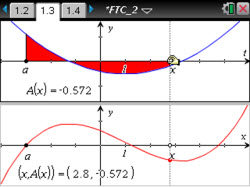
Students make visual connections between a function and its definite integral.
Objectives
- Students will be able to identify the graphical connections between a function and its accumulation function.
- For a given function, students will recognize the accumulation function as an antiderivative of the original function.
- Students will be able to apply and explain the second Fundamental Theorem of Calculus.
- Construct viable arguments and critique the reasoning of others. (CCSS Mathematical Practice)
- Look for and make use of structure. (CCSS Mathematical Practice)
Vocabulary
- accumulation function
- definite integral
- antiderivative
About the Lesson
The intent of this lesson is to help students make visual connections between a function and its definite integral.
- Students will use the accumulation function with a fixed starting point to find definite integrals of a function over different intervals.
- Students will observe that the accumulation function is an antiderivative of the original function.
- Students will apply the antiderivative property of the accumulation function in combination with their use of the accumulation function to determine a definite integral.
- The lesson concludes with students stating and applying an informal statement of the second Fundamental Theorem of Calculus.
- This lesson is designed to follow the lesson The First Fundamental Theorem of Calculus.

Download Files
Math: Calculus: Fundamental Theorem
Math: AP Calculus: AP Calculus
9-12
45 Minutes
TI-Nspire™ CX series
TI-Nspire™ CX CAS/CX II CAS
3.0
Lessons
TNS
iPad is a trademark of Apple Inc., registered in the U.S. and other countries.
Vernier EasyData,Vernier EasyLink and Vernier EasyTemp are registered trademarks of Vernier Science Education.
Vernier EasyData,Vernier EasyLink and Vernier EasyTemp are registered trademarks of Vernier Science Education.