

Margin of Error and Sample Size
Math: Statistics: Confidence Intervals
9-12
45 Minutes
TI-Nspire™ CX series
TI-Nspire™ CX CAS/CX II CAS
3.0
Lessons
TNS
Margin of Error and Sample Size
Activity Overview
This activity investigates the margin of error for a confidence interval and the relationship between sample size and the margin of error.
Objectives
- Students will interpret a confidence interval for a population proportion as an estimated range of values that is likely to contain the actual population proportion.
- Students will estimate the margin of error for a generated confidence interval and express the confidence interval in terms of the margin of error.
- Students will recognize that as sample size increases, the margin of error decreases.
About the Lesson
This activity investigates the margin of error for a confidence interval and the relationship between sample size and the margin of error.
This activity will give students the following opportunities:
- Select an observed proportion of successes from a random sample chosen from an unknown population.
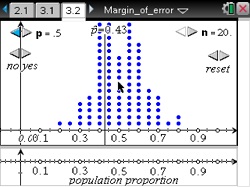
- Examine simulated sampling distributions of proportions for samples drawn from known populations and decide whether the observed proportion seems likely to have come from this population; if so, a point is marked on a number line representing likely population proportions.
- Repeat sampling for a sequence of known population proportions until an interval of successes—a confidence interval—is marked on a horizontal axis.
- Express a confidence interval in terms of a sample proportion and the margin of error.
- Experiment with changing the sample size for a given observed proportion and note the change in the confidence interval and consequently the margin of error.

Math: Statistics: Confidence Intervals
9-12
45 Minutes
TI-Nspire™ CX series
TI-Nspire™ CX CAS/CX II CAS
3.0
Lessons
TNS
iPad is a trademark of Apple Inc., registered in the U.S. and other countries.
Vernier EasyData,Vernier EasyLink and Vernier EasyTemp are registered trademarks of Vernier Science Education.
Vernier EasyData,Vernier EasyLink and Vernier EasyTemp are registered trademarks of Vernier Science Education.