TI-84 Plus Family Featured Activities Archive for High School
| Topic |
|---|
-
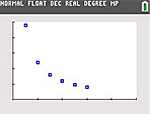
Inverse Variation
Students explore the inverse variation function with a geometric representation (a rectangle with fixed area), a table of values, an algebraic expression, and a graph.c
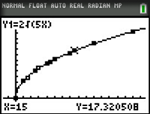
Stop!
Students will use an interactive page to calculate the speed of the car, given a stopping distance, and then approximate stopping distance, given the rate of the car.
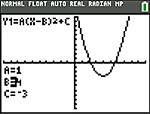
Graphing Quadratic Functions
Students will explore the inverse variation function with a geometric representation (a rectangle with fixed area), a table of values, an algebraic expression, and a graph.
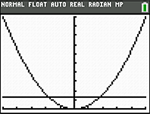
Introducing the Parabola
Students will plot the points from the table and examine the graph and its properties.
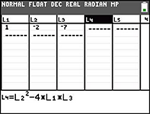
Quadratic Formula
Students will make connections between the visual ways to find zeros of a parabola and algebraic ways with an emphasis on the quadratic formula.
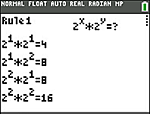
Exponent Rules
Students will discover rules for working with exponents, such as the Power of a Power rule and investigate the value of a power whose exponent is zero or negative.
Going Into Business
Students will translate fixed and variable costs of a cost function and make a decision about how much to charge to wash per dog.
Chirp, Jump, Scatter
Students will find a best fit line for data graphed as scatter plots.
Trains in Motion
Students will make observations about the motion of two objects. They will compare and contrast this motion and consider how it corresponds to a graph representing distance as a function of time.
Back In Time?
Students will explore the definition of a function through use of a graph, a set of ordered pairs, and an input-output diagram.
Supertall Skyscrapers
Students use scaled measurements and proportions to find the heights of skyscrapers.

Linear Inequalities
Students investigate single-variable inequalities on a number line and as a table of values.

One Step at a Time
Students use repeated results from calculations to formulate and test a hypothesis about solving one-step equations.

Raise Your Cup
Students will explore writing and graphing inequalities. Students will solve inequalities to determine the height for a cup that needs to hold at least 12 ounces. They will use a trial and error method, entering values into the table to compute their range of answers.
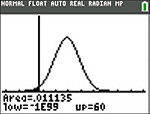
Areas in Intervals
Students will estimate and find a given area under a normal curve.
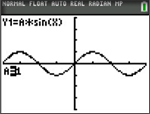
Vertical and Phase shifts
Students will explore vertical and phase shifts of sine and cosine functions.
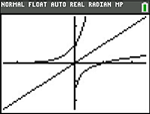
Exponential Reflections
Students will determine that the inverse of the exponential function is the natural log function by plotting the inverse of exponential solution points.
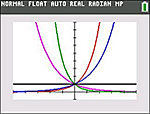
Exponential Growth
Students will find an approximation for the value of the mathematical constant e and to apply it to exponential growth and decay problems.
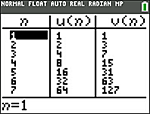
Geometric Sequences & Series
Students will find common ratios of geometric sequences on a spreadsheet and create scatter plots of the sequences to see how each curve is related to the value of the common ratio.
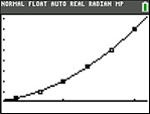
Stacking Bricks
Students will use a polynomial function to model a real world problem.
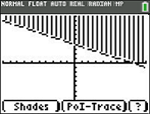
Border Patrol
Students will graph a system of linear inequalities to determine if a points lies in the solution.
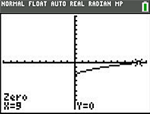
Roots of Radical Equations
Students will solve square root and cube root equations graphically.
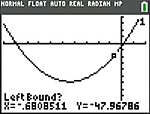
Watch Your P's and Q's
Students will then use the Rational Zero Theorem to find all the potential rational zeros of the function.
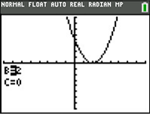
Just Move it
Students explore transformations of parent functions by comparing changes in the equations to their graphs.

Airport Impact Study
Students develop a model to analyze and explain data collected in an airport noise impact study.

Area of the Missing Square
Students will use an area model to represent and explore patterns in the structure of the quadratic equation.

Operating on Matrices
Students will perform operations on matrices. Using teacher discussion questions, students can determine the row and column properties of matrices to conclude when the operations can be performed.