TI-Nspire Featured Activities Archive
| Topic |
|---|
-
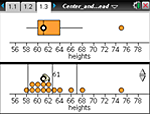
Center and Spread
Content Standard: HSS-ID.A.2
Students will recognize that the mean and standard deviation (SD) and the median and interquartile range (IQR) are two ways to measure center and spread.
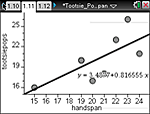
Tootsie Pops & Hand Span
Content Standard: HSS-ID.B.6a
Students will collect data, find the linear regression model of the data, and address aspects of the data that affect regression.
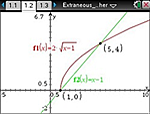
Extraneous Solutions
Content Standard: HSA-REI.A.1
Students will discover solutions of radical equations and investigate extraneous solutions. Students will find a solution algebraically and use technology to graphically find them.
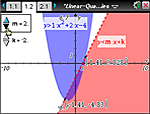
Linear-Quadratic Inequalities
Content Standard: HSA-REI.D.12
Students will use sliders to control the intersection of a quadratic and a linear inequality.
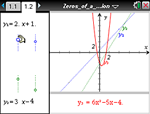
Zeros of a Quadratic Function
Content Standard: HSA-APR.B.3
Students will use sliders to change the linear factors of a quadratic function. Students will connect the zeros of the quadratic function to the zeroes of the linear factors.
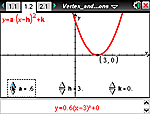
Vertex and Factored Forms of the Quadratic Function
Content Standard: HSF-IF.B.4
Students will be able to identify and justify the effect of changing the parameters of a quadratic function in vertex form and factored form.
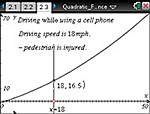
Quadratic Functions and Stopping Distance
Content Standard: HSA-REI.A.1
Students will analyze and compare data for stopping distances for 3 conditions: normal conditions, talking on a cell phone, and a wet road.
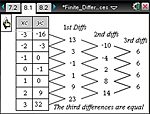
Finite Differences
Content Standard: HSF-IF.A.3
Students will investigate into the set of differences for linear, quadratic, and cubic functions.
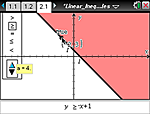
Linear Inequalities in two Variables
Content Standard: HSA-REI.A.1
Students will discover the basics of graphing a linear inequality.
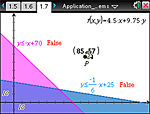
Applications of Linear Systems
Content Standard: HSA-REI.C.6
Students will use a system of linear inequalities to solve a problem a real world problem about parking cars and buses.
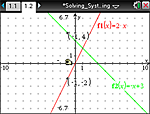
Solving Systems by Graphing
Content Standard: HSA-REI.C.6
Students will compare a linear and an exponential relationship using both a spreadsheet and scatter plots.
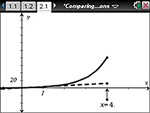
Comparing Linear and Exponential Functions
Content Standard: HSF-LE.A.1a
Students will compare a linear and an exponential relationship using both a spreadsheet and scatter plots.
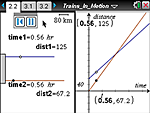
Trains in Motion
Content Standard: HSF-BF.A.1a
Students will visualize a solution to a system of equations and will explore a system that intersects in one point and identify the ordered pair that represents the solution.
How Many Solutions to the System?
Content Standard: HSF-IF.B.4
Students will translate and rotate a line to visualize that a system of equations can have a unique solution, infinitely many solutions, or no solution.
Multiple Representations
Content Standard: HSF-IF.B.4
Students will explore information represented in tables, graphs, and symbols to interpret the meaning of slope and intercepts in the context of a real world situation.
Domain and Range
Content Standard: HSF-IF.A.1
This lesson involves identifying a set of x-values in both symbols and words, identifying the set of x-values used in generating the function as the domain of the function, and identifying the set of y-values used in generating the function as the range of the function.
-
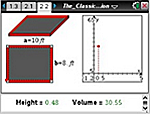
The Classic Box Problem - Exploration
Content Standard: HSG-GMD.A.3
Students will use multiple linked graphical, geometric (2D and 3D), and numeric representations to model a classic optimization problem.
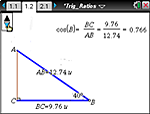
Trig Ratios
Content Standard: HSG-SRT.C.8
Students will work with triangles and trigonometric ratios.
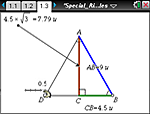
Special Right Triangles
Content Standard: HSG-SRT.C.8
Students will study the 30-60-90 and 45-45-90 triangles.
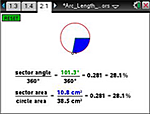
Arc Length and Sectors
Content Standard: HSG-C.B.5
Students will recognize that the sum of two central angles that combine to make a circle is 360°.
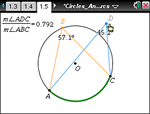
Circles: Angles and Arcs
Content Standard: HSG-C.A.2
Students will explore the relationships between angles and the arcs formed when they intersect circles different ways.
Creating a Midpoint Quadrilateral
Content Standard: HSG-GPE.B.7
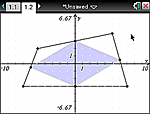
Students will focus on the idea that the midpoints of any quadrilateral form a parallelogram. Area relationships will also be investigated.
Similar Figures
Content Standard: HSG-SRT.A.2
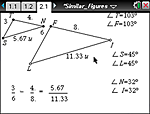
Students will observe ratios of pairs of sides in geometric shape to discover when they are similar.
Corresponding Parts of Congruent Triangles
Content Standard: HSG-SRT.B.5
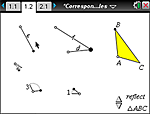
Students will identify corresponding parts of congruent triangles and use appropriate notation to describe two congruent triangles.
Nested Similar Triangles
Content Standard: HSG-CO.C.9
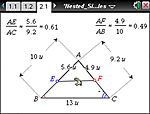
Students will identify conditions for similar triangles that are nested and share a common angle.
Exploring Perpendicular and Angle Bisectors
Content Standard: HSG-CO.B.8
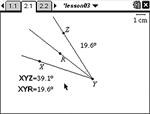
Students will define and investigate the properties of both a perpendicular bisector and an angle bisector.
Side-Side-Angle: The Ambiguous Case
Content Standard: HSG-CO.B.8
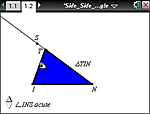
Students will identify the conditions necessary to determine a unique triangle when given two sides and a non-included angle.
Transformations with Lists
Content Standard: HSG-SRT.A.1
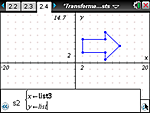
Students will use lists to investigate transformations of geometric figures.
Transformations: Rotations
Content Standard: HSG-CO.A.2
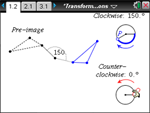
Students will explore rotations and geometric figures.
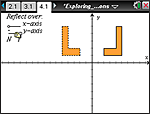
Exploring Transformations
Content Standard: HSG-CO.A.2
Students will investigate transformations of geometric figures.
Special Segments in Right Triangles
Content Standard: HSG-CO.D.12
Students will investigate four special segments from a given vertex in a triangle and identify relationships among the special segments and the angles that they form.
Points, Lines and Planes
Content Standard: HSG-CO.A.1
In this lesson, students will identify, recognize and discuss many properties of lines and planes.
-
Finite Differences
Content Standard: HSA-APR.C.
Students will investigate inot the set of differences for linear, quadratic and cubic functions.
Conditional Probability
Content Standard: HSS-CP.A.5
Students will investigate the difference between the probability of an outcome and the conditional probability of an outcome.
Contingency Tables and Chi Square
Content Standard: HSS-CP.A.2
Students will investigate chi-square as an indication of whether two variables in a population are independent or associated.
Statistics: Tossing Coins
Content Standard: HSS-ID.A.1
Students will use a simulation to find the experimental probability of independent events, tossing two coins. Then they will compare it to the theoretical probability.
Birthday Problem
Content Standard: HSS-CP.A.1
Students will compute the probability that two people in a group will share a common birthday.
Probability of Repeated Independent Events
Content Standard: HSS-IC.A.2
Students will investigate probability by simulating tossing a coin three times.
Airport Impact Study
Content Standard: HSS-ID.B.6a
Students will perform a simulation to measure the sound intensity at different distances from the source of the noise, and then use the data to develop an inverse variation model.
The Painted Cube
Content Standard: HSA-CED.A.2
Students will model numerical data obtained from an application problem using linear, quadratic and cubic functions.
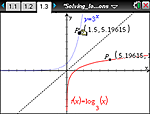
Solving Logarithmic Equations
Content Standard: HSF-BF.B.4a
Students will explore numeric, graphic, and symbolic approaches to solving logarithmic equations.
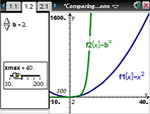
Comparing Exponential and Power Functions
Content Standard: HSF-LE.A.1
Students will develop and test conjectures about the relative size and growth of power functions and exponential functions using graphical representations.
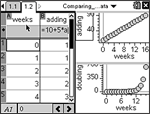
Comparing Linear and Exponential Data
Content Standard: HSF-LE.A.1
Students will use a table and a graph to compare the changes in linear and exponential expressions as x is increases.
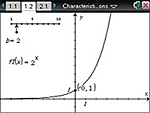
Characteristics of Exponential Functions
Content Standard: HSF-IF.C.7e
Students will investigate how the graph of an exponential function changes when 0 < b < 1, b = 1, or b > 1.
Exploring Power Functions 2
Content Standard: HSF-IF.C.7
Students investigate power functions with a slider to discover the connection among power functions and radical and rational functions.
Exploring Polynomials: Factors, Roots, and Zeros
Content Standard: HSA-APR.B.3
This lesson merges graphical and algebraic representations of a polynomial function and its linear factors.
Domain and Range 2
Content Standard: HSF-IF.C.9
Students will explore discrete and continuous relations to identify and express the domain and range.
Families of Functions
Content Standard: HSF-BF.B.3
This lesson involves changing the values for a, h and k and observing the effects on the graphs. The types of functions include quadratic, absolute value, exponential, logarithm, cubic and sine functions.
-
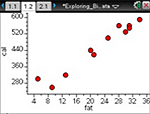
Exploring Bivariate Data
Content Standard: 7.SP.B.3
Students will investigate the relationship between two quantities to determine the nature of the relationship between them.
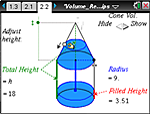
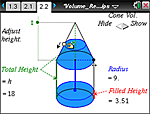
Volume Relationships
Content Standard: 6.G.A.2
Students will determine the formula for the volume of a cylinder and relating it to the volume of a cone and sphere.
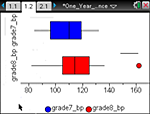
One Year Makes A Difference
Content Standard: 7.SP.B.4
Students will use box plots and histograms to compare data from two groups.
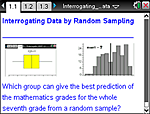
Interrogating Data By Random Sampling
Content Standard: 7.SP.A.1
Students will take samples from a population to approximate the mean.
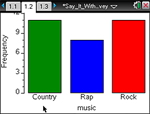
Say It With a Survey
Content Standard: 6.SP.B.4
Students will graphically examine the results of a survey to determine patterns.
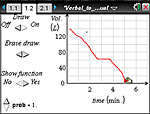
Verbal to Visual
Content Standard: 6.NS.6
Students will create graphs that model different scenarios.
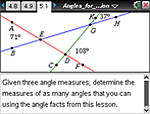
Angles for a Solution
Content Standard: 7.EE.B.4
Students will use angle properties to find missing angles in given figures.
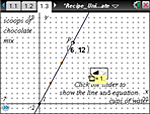
Recipe: Unit Rate
Content Standard: 6.RP.3
Students will use a ratio to create and plot points and will determine a mathematical relationship for plotted points. They will also compute the unit rate and predict ordered pairs.
The Pentagon Problem
Content Standard: 7.G.A.2
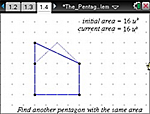
Students will compare the area of differently shaped pentagons to determine a variety of ways to make figures with the same area.
Getting A-round Area
Content Standard: 7.G.A.1
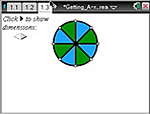
Students will explore the area of a circle by rearranging it's slices and comparing to a parallelogram.
Scaling the Geometry
Content Standard: 7.G.A.1
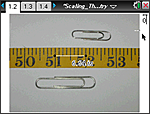
Students will use scaling to measure items in photos using known lengths.
Proportions in Stories
Content Standard: 7.RP.A.1
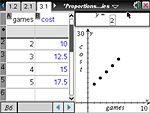
Students will analyze a scatter plot of data, generalize a rule to describe the data, and graph the function that describes the rule to verify that it matches the scatter plot.
Proportionality in Tables, Graphs and Equations
Content Standard: 6.RP.1
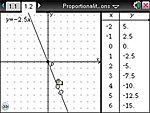
Students will recognize and identify the characteristics of proportional and non-proportional relationships by analyzing a table, equation, and graph.
Solving Percent Problems
Content Standard: 7.RP.A.3
Students will analyze the percent equation for problems and make connections between verbal, visual, and numerical representations to establish patterns in solving percent problems.
Bathroom Flooring
Content Standard: 6.NS.B.4
Students will use visual representations of fractions to estimate the area of irregular shapes.
Multiplication of Rational Numbers
Content Standard: 6.NS.1
This lesson involves using an interactive area model to solve multiplication and division problems with positive decimals and mixed numbers.
-
Scatterplot Pulse Rates
Content Standard: 8.SP.A.1
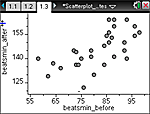
Students will identify the graphical representations of residuals from the graph of a data set and a line modeling the relationship between the explanatory and response variables.
Linear Modeling
Content Standard: 8.SP.A.2
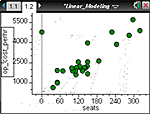
Students will find linear relationship between different sets of variables and explain the connections between variables.
Lines of Fit
Content Standard: 8.EE.B.6
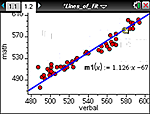
Students will manually find a trend line for given data the answer questions on the topic.
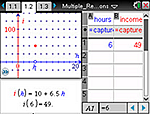
Multiple Representations
Content Standard: 8.EE.B.5
Students will interpret information represented in tables, graphs, and symbols. Students will be able to find the slope from a table, from a graph, and in an equation.
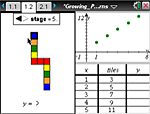
Growing Patterns
Content Standard: 8.EE.B.5
Students will build patterns with tiles and observe the data in a table and scatter plot. A formula for the pattern will be discovered.
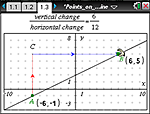
Points on a Line
Content Standard: 8.F.A.1
Students will grab and drag points on a fixed line to recognize that the ratio of the vertical and horizontal change is always correct.
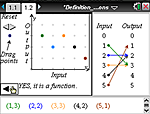
Definition of Functions
Content Standard: 8.F.A.1
Students will use a table and a plot of ordered pairs to determine the definition of a function.
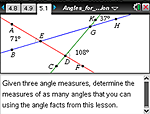
Angles for a Solution
Content Standard: 8.EE.7.Ca
Students will use angle properties to find missing angles in given figures.
Volume Relationships
Content Standard: 8.G.B.9
Students will determine the formula for the volume of a cylinder and relating it to the volume of a cone and sphere.
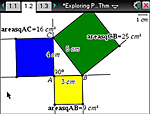
Exploring the Pythagorean Theorem
Content Standard: 8.G.A.3
Students will develop the Pythagorean Theroem, find missing sides in right triangles and connect the Pythagorean Theorem to finding the distance between two points in the coordinate plane.
Exploring Transformations
Content Standard: 8.G.A.3
Students will explore tranformations of geometric figures and identify the coordinates of a shape that has been translated or reflected.
Transformers in the Classroom
Content Standard: 8.G.A.2
Students will trace over objects, digitize them, and then manipulate the ordered pairs that represent the shape to transform it in various ways.
Ratios of Similar Figures
Content Standard: 8.G.A.4
Students explore the ratio of perimeter, area, surface area, and volume of similar figures in two and three dimensional figures.
Repeating Decimals and Fractions
Content Standard: 8.NS.A.1
Students will investigage repeating decimals and their equivalent fractions.
Exploring Exponents
Content Standard: 8.EE.A.1
Students will know and apply the properties of integer exponents to generate equivalent numerical expressions.
Comparing Pi's and Roots
Content Standard: 8.NS.A.1
This lesson involves manipulating the radius of a circle and the sides of a right triangle in an attempt to set the circumference of the circle equal to the hypotenuse of the right triangle.