Browse Activities | TI-84 Plus Family - Middle School
Statistical Plots
Students will determine what they can infer about the data and how the graph varies from the other types of graphs.
We Have the Same Birthday
Students use simulations to answer a popular question involving probabilities.
Are There Any Seats Left?
Students will use a simulation to understand why airline companies routinely overbook flights.
Breathtaking Scatter Plots
Students will gather data by recording estimates of how long they think they can hold their breath and the actual amount of time.
Estimating Square Roots
Students will develop an understanding of the relationship between a number and its square root.
Scientific Notation
Students will see where large and small numbers are used and how scientific notation offers a convenient method of writing such numbers.
Regressions of Olympic Proportions
Students will find lines of best fit to model Olympic data.

Working Hard or Hardly Working?
Students analyze univariate and bivariate data and use this as a basis to justify conclusions thay make about the data.

You are What You Eat
Students use linear equations to model and compare data from the amount of fat and calories in fast food hamburgers.

Box Plots and Histograms
Students create and explore a box plot and histogram for a data set. They then compare the two data displays by viewing them together and use the comparison to draw conclusions about the data.
Vertical Angles
Students will visualize and explore the angles that are formed when two lines intersect.
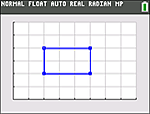
Comparing Areas of Rectangles
Students discover the relationship between a change in the dimensions of a rectangle and the change in the corresponding area.
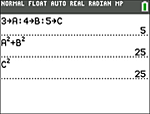
Making Triangles
Students will investigate properties of triangles, classify the various types of triangles, and determine if specific side lengths will make a triangle or not.
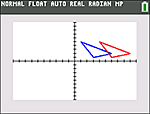
Move It!
Students will investigate transformation, slides and scaling, of a triangle using lists.
Changing Before My Eyes
Students will explore multiplication and division of fractions using several representations to develop fluency.
Mirror, Mirror, on the Graph
Students apply transformations to points on a grid and use symmetry to analyze mathematical situations.
The Same Name Game
Students explore the meaning and purpose of equivalent fractions. They also practice writing fractions that meet a given criteria.
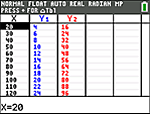
Calculating Sale Prices
Students will find discounts and sale prices by using tables. They will then find the general rules, using a variable, for finding those discounts and prices.
The Rule of Four
Students will look at problems algebraically, graphically, verbally, and numerically to represent situations.
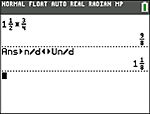
Visualizing Fractions
Students will explore multiplication and division of fractions using several representations to develop fluency.
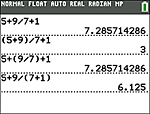
Where Did the Parentheses Go?
Students use the order of operations and number properties to create a unique expression from a set of numbers that must equal another number.
Using Venn Diagrams to Find the GCD
Students investigate the number relationships using Venn diagrams.
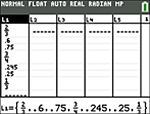
Ordering Fractions, Decimals, and Percents
Students compare and order fractions, decimals, and percents using a number line.

Common Denominator
Students use an interactive spreadsheet to create a common denominator for two fractions and discuss why a common demoniator is needed to add and subtract fractions.

Taxes & Tips
Students explore commonly used taxes and tips percentages to develop the pattern for converting a percent to a decimal.

Factoring Composite Numbers
Students will review some of the terms associated with prime factors. A Frayer Model (Square) is provided allowing the teacher to assess students’ knowledge of the concept prime.
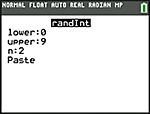
Drawing Conclusions
Students learn about the concept of collecting and analyzing data and using conjectures to formulate new questions.
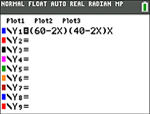
Creating Boxes
Students will graph the relationship between the length of the sides of the cut-out squares and the volume of the resulting box.
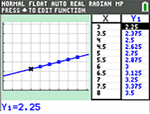
The Variables of Renting
Students will identify what a variable is, construct a table of values, graph the ordered pairs from the table, and graph the equation.
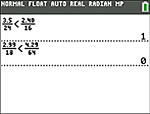
Calculating Unit Prices
Students will compare ratios with different denominators, and then with common denominators.
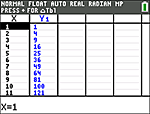
Square Tables
Students will use a table to discover patterns in square numbers and will use the patterns as a model to solve problems.
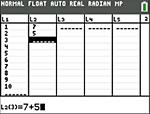
The Magical Growth of Numbers
Students learn to use tools for performing computations with lists of numbers and to explore the Distributive Property.