| Module 7 - Answers |
| Lesson 1 |
| Answer 1 |
|
7.1.1
|
|
|
|
|
| Answer 2 |
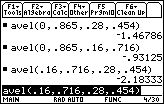
| 7.1.2 The book fell faster during the subinterval from t = 0.16 to t = 0.28. |
|
|
|
| Lesson 2 |
| Answer 1 |
|
7.2.1
Average velocities: 2.1 m/s; 1.933 m/s; 1.75 m/s
|
|
|
|
|
| Answer 2 |
| 7.2.2 The best approximation is 1.75 m/s, which is the average velocity for the interval (0.16, 0.716) to (0.18, 0.681). It best approximates the instantaneous velocity because the elapsed time interval is the smallest of the three. |
|
|
|
|
| Answer 3 |
|
7.2.3
|
|
|
|
|
| Lesson 3 |
| Answer 1 |
| 7.3.1 1.64509 m/s; 1.64914 m/s; 1.64955 m/s |
|
|
|
|
| Answer 2 |
| 7.3.2 Yes. This average velocity is also 1.6496 m/s, which is equal to the instantaneous velocity. |
|
|
|
|
| Self Test |
| Answer 1 |
|
The ball averaged approximately 0.6 m/s over the interval from t = 0.16 to t = 0.48, traveling in an upward direction. |
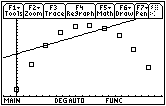
| Answer 2 |
|
| Answer 3 |
|
2.1401 m/s
|
| Answer 4 |
|
| Answer 5 |
| 2.1447 m/s |
| Answer 6 |
| 2.1447 m/s; The ball was traveling approximately 2.1447 m/s at t = 0.16 in an upward direction. |
|
|
|
©Copyright 2007 All rights reserved. | Trademarks | Privacy Policy | Link Policy |