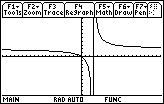
It appears that:
Vertical asymptote: x = 3
Horizontal asymptote: y = 2
You cannot really be sure from the graph. You need to apply analytic techniques as we will illustrate.


 3–, f(x)
–
3–, f(x)
–
 . As x approaches 3 from the right, the function values are positive and increase without bound. Symbolically, as, x
3+, f(x)
. As x approaches 3 from the right, the function values are positive and increase without bound. Symbolically, as, x
3+, f(x)
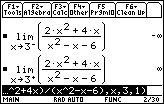
Because the values of the function in absolute value increase without bound as x approaches 3 from the left and from the right, x = 3 is a vertical asymptote. Notice that
 means as x
3–, f(x)
–
means as x
3–, f(x)
–
 means as, x
3+, f(x)
means as, x
3+, f(x)
2 as x
–
and as x
.
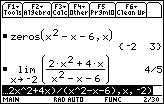
Because
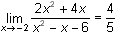 , which is not
or –
, x = –2 is not a vertical asymptote.
, which is not
or –
, x = –2 is not a vertical asymptote.
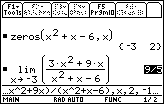
Because
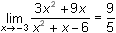 , there is a hole at x = –3 and not a vertical asymptote there.
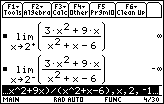
Because
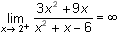 and
and
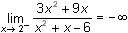 , x = 2 is a vertical asymptote.
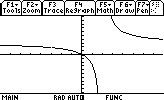
The Window values shown are [–7.9, 7.9] x [–10, 10] with xres = 1.
There is a tiny hole at
 and x = 2 is a vertical asymptote. Because xres is 1 and a pixel represents x = 2, the calculator evaluated the function at x = 2 and determined that the function was not defined there. That is why there is no vertical line shown at x = 2.
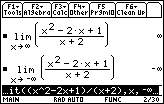
Because the function does not approach a finite real number as the magnitude of x gets large without bound, no horizontal line is an asymptote.
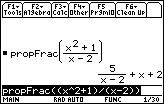
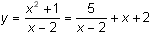
The vertical asymptote is x = 2 and the oblique asymptote is y = x + 2. In a large window the graph of
 is similar to y = x + 2, the oblique asymptote. In a window near x = 2 the graph is similar to
 .
.
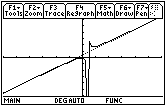
The Window shown is [–30, 30] x [–30, 30], xscl = yscl = 5, and the oblique asymptote y = x + 2 is shown as a dotted line.
The style of a selected graph may be chosen from the Style menu, which is displayed by pressing

 in the Y= editor while the function in question is highlighted. The style of y = x + 2 was chosen to be dotted.
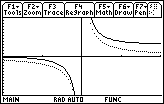
The Window shown is [0, 4] x [–25, 25]. The graph of
is shown as a dotted curve.
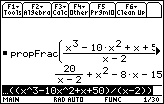
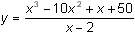 looks like the graph of the parabola y = x2 – 8x – 15 in a large viewing window and like the graph of
 in a smaller window near x = 2.
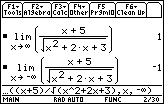
The two horizontal asymptotes of this function are y = 1 and y = –1.
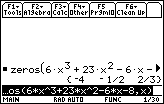
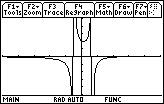
[–5, 5] x [–5, 5]
There appear to be vertical asymptotes at
 and
and
 but not x = – 4
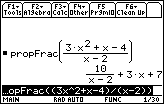
 will resemble the graph of the line y = 3x + 7 in a large viewing window. It will resemble the graph of
 in a small window near x = 2. The graph of
has a vertical asymptote at x = 2.
in a small window near x = 2. The graph of
has a vertical asymptote at x = 2.
©Copyright 2007 All rights reserved. | Trademarks | Privacy Policy | Link Policy